The pitch
On October 6, 2023, Israeli speculative fiction already knew how to imagine catastrophe. For decades its writers had explored war, occupation, siege, terrorism, messianic temptation, military memory, surveillance, technological dread, family fracture, exile, and the peculiarly Israeli discipline of maintaining ordinary life under abnormal conditions. Then October 7 happened. The stories did not become obsolete. They became newly audible.
The Elephant in the Airlock: Israeli Speculative Fiction Before & After October 7 is an anthology of Israeli science fiction, fantasy, surrealism, and speculative literature built around that change in pressure. Its central question is immediate: what happens to a national literature of the imagination when reality crosses a threshold that fiction had long approached indirectly?
The anthology’s larger literary question is this: What happens to a culture’s imagined future when the future it had imagined is violently interrupted?
The futures Israel imagined
Israeli speculative fiction has always emerged from an unusual relationship with the future. The country itself was preceded by acts of political and cultural imagination: visions of a society that did not yet exist, followed by the difficult business of creating and inhabiting it. Israeli writers subsequently used science fiction and fantasy to imagine other futures shaped by war and peace, technology and religion, utopian aspiration and dystopian anxiety.
October 7 created a rupture in that imaginative landscape. Assumptions about security, borders, coexistence, national identity, and the future itself were suddenly thrown into question. Yet literature does not divide neatly into a before and an after. Stories written before a catastrophe can acquire meanings their authors never anticipated; stories written afterward carry memories of futures that no longer seem possible.
The Elephant in the Airlock places these imaginative worlds in conversation. By bringing together Israeli speculative fiction written on both sides of the rupture, the anthology allows readers to experience the change rather than simply being told that it occurred. Earlier stories become newly legible beside later ones. The result is not a political brief or a collection organized around a single national response, but a literary record of a society confronting a profound disruption in its relationship with the future.
This is why the anthology needs to exist now. It captures a moment when the speculative imagination itself is being renegotiated—when writers are asking not only what comes next, but whether the assumptions that once made particular futures imaginable can survive.
The book therefore speaks beyond Israel. Every society imagines its future from within assumptions that seem stable until history overturns them. Israeli speculative fiction offers an unusually concentrated case of what happens when that process becomes visible. The Elephant in the Airlock documents the moment when the future imagined before the rupture encounters the future that must be imagined after it.
After Zion’s Fiction
This is not a third Zion’s Fiction volume. Zion’s Fiction: A Treasury of Israeli Speculative Literature (2018) established for English-language readers that Israeli speculative fiction constituted a substantial field. More Zion’s Fiction: Wondrous Tales from the Israeli ImagiNation (2021) broadened the map. The Elephant in the Airlock changes the frame. It places stories written before and after the rupture in chronological conversation, allowing readers to experience what continues, what fractures, what intensifies, and what can no longer be heard in quite the same way.
Edited by Sheldon Teitelbaum, co-editor of the internationally recognized Zion’s Fiction anthologies and a four-decade observer of Israeli speculative literature, the collection builds on an established network of writers, translators, scholars, and international readers.
Most of the selected stories were written in Hebrew, and many have never been available in English. Translation is therefore not a secondary production matter but part of the anthology’s literary creation in English. The project will require first-rate translators capable of preserving the voices, registers, political nuances, black humor, military language, religious references, and speculative inventions of the originals.
Why an elephant in an airlock?
The title relocates the familiar elephant in the room into the language of science fiction. October 7 is the elephant: not the explanation for every story, but the event that changes the pressure around them. The airlock is speculative fiction itself—a threshold chamber through which writers move between the real and imagined. The anthology asks what can still be displaced, confronted, joked about, mourned, or left unsaid once the atmosphere changes.
The book refuses the easiest available roles. It is neither propaganda nor indictment, neither documentary testimony nor a political position paper disguised as literature. Its writers disagree.
Some foreground Jewish and Israeli vulnerability, terror, grief, and survival. Others expose occupation, state power, denial, violence, corruption, or messianic danger. Some do both. The objective is not manufactured balance but literary complexity.
What fiction can say about October 7
International discussion of Israel since the attacks and their aftermath has been dominated by reportage, history, argument, accusation, advocacy, and counter-advocacy. Fiction offers another instrument. Speculative fiction can literalize pressures public language flattens: trauma can become a malfunctioning universe; political desperation can summon a candidate from the future; ruined Israeli cities can become landscapes viewed by outsiders; inherited conflict can be estranged through aliens, alternate histories, prophecy, horror, satire, and myth.
The earlier stories make the later stories more powerful because they demonstrate that the catastrophe did not invent Israeli speculative literature’s anxieties. Long before 2023, writers were using alternate history, theological fantasy, cyborg bodies, military ghosts, infrastructure sabotage, cosmic exile, and prophetic bureaucracy to approach realities conventional realism could not comfortably contain. After the rupture, those imaginative forms operate under altered atmospheric pressure.
The Elephant in the Airlock therefore combines urgency with durability. Its historical hinge is immediately legible, but its literary argument extends beyond the news cycle. It is a book about how imaginative literature registers catastrophe before and after catastrophe becomes history.
The volume will open with a foreword by Larry Niven, one of science fiction’s most influential and widely recognized writers and a longtime friend of Israeli science fiction. Niven’s presence gives the anthology an immediate bridge to the international science-fiction readership and places these Israeli stories within the larger tradition of the field rather than treating them as a political or regional curiosity. The volume will close with an afterword by Valerie Estelle Frankel, placing the stories within the wider traditions of Jewish imagination, folklore, trauma, and popular culture.
The book
The anthology will be organized chronologically, with a visible division between work written before and after the rupture. Each description identifies the premise, the story’s literary pressure, and the reason it belongs. The cumulative purpose is to show how the anthology’s mission arises from the stories themselves: from recurrence, mutation, pressure, altered tone, changing formal strategies, and the newly unavoidable prominence of public catastrophe.
Before October 7: Pressure Texts
Pesach (Pavel) Amnuel, “The World is a Mirror” (1994)
Originally published in Russian and later associated with Amnuel’s Institute of Alternative Histories sequence, “The World is a Mirror” is one of the clearest examples of earlier Israeli speculative fiction confronting the political reality that much of the genre tended to evade or displace. The story begins as a procedural: an Israeli Arab murder suspect escapes justice by entering an alternate historical reality. But the alternate world into which the historian-protagonist follows him is a brutal inversion of Israeli history: Israel does not exist, Jews live as a degraded and policed minority in an Arab-ruled Palestine, and the familiar architecture of sovereignty, resentment, humiliation, underground violence, and state power has changed hands. The story belongs because alternate history becomes not an escape from politics but a mechanism of self-recognition.
Gail Hareven, “To See What’s Coming” (1999)
Hareven’s story imagines a future Knesset of Humankind in which citizens are summoned into prophetic trance and asked to gather fragments of information from future eras so that a priestly bureaucracy can postpone the end of the species. Its narrator begins as a believer in repair, hierarchy, and necessary secrecy, but a vision of caged children breaks the spiritual and political architecture that has sustained her obedience. Here, the story is foundational because it dramatizes an Israeli speculative imagination already preoccupied with catastrophe, intergenerational responsibility, institutional concealment, and the unbearable moral cost of knowing what is coming without being able to intervene.
Vered Tochterman, “All Human Beings, in Peace and Brotherhood” (2003)
Tochterman’s mordant first-person story begins in the voice of a casually racist Israeli narrator who insists that he is not really a racist, only to find himself fighting alongside Palestinians and other former enemies when aliens invade and render familiar hatreds suddenly inadequate. The story’s comic abrasiveness is part of its force: it exposes prejudice without smoothing it into liberal uplift, and it imagines solidarity not as moral enlightenment but as a panicked, provisional, necessary response to a larger threat. It helps define the older mode of Israeli SF/F: a work that approaches the Israeli-Palestinian catastrophe indirectly, through alien invasion and satiric reversal, while still placing coexistence, humiliation, and the absurdity of inherited enmity at the center of the speculative mechanism.
Lavie Tidhar, “The Gimatria of Pi” (2004)
Tidhar’s story brings together Jewish textual play, number mysticism, mathematical infinity, and the fear that interpretation itself may become a trapdoor into apocalypse. Its speculative force lies in the way it treats code, scripture, and calculation as unstable instruments: systems designed to reveal order that may instead expose a terrifying excess of meaning. Here, the story functions as a bridge between intellectual play and existential pressure, approaching catastrophe through language, numerology, and metaphysical indirection.
Hagai Averbuch, “God Is Pure as an Equation, Sweet as Kanafeh, Straight as the Smoke Rising from the Incense Altar” (2005)
Averbuch’s dense, hallucinatory story moves through soldiers, prison memories, machine bodies, drugged visions, desert faith, erotic longing, and the backwash of human memory that persists inside the cyborged dead. Its world is militarized, hybridized, and spiritually deranged; the human body becomes a battlefield where theology, technology, desire, and violence continue to speak after ordinary life has been shattered. The story belongs because it shows how, well before the rupture, Israeli speculative fiction could absorb war and occupation into surreal systems of embodiment and revelation rather than conventional realism.
Aviel Tochtermann and Keren Landsman, “Green DBG” (2016)
“Green DBG” alternates between a militant cell member planning sabotage against infrastructure and a civilian whose return to ordinary life after an attack is shadowed by bruises, surveillance, withdrawal, and the uneasy pull of radicalization. The story’s speculative architecture is also civic: tunnels, grids, cables, cells, railway plans, and security systems become the visible nerves of a society in which violence is organized, routinized, and politically contagious.
It shows the earlier field already imagining internal fracture and infrastructure war not as distant dystopia, but as a plausible extension of ordinary Israeli life.

Yuval Yavne, “Taking Brigadier General Haruvi” (2020)
Yavne’s story follows Captain Gadi Shenhar as he arrives at the home of retired Brigadier General Haruvi, a legendary figure from the world of deep-behind-enemy-lines operations, and carries out a mission whose calmness makes it chilling. The plot turns on military memory, secrecy, loyalty, decline, and the afterlife of old operations inside a system that continues to demand obedience from those it has already consumed. It belongs as an earlier meditation on the Israeli security state and its ghosts.
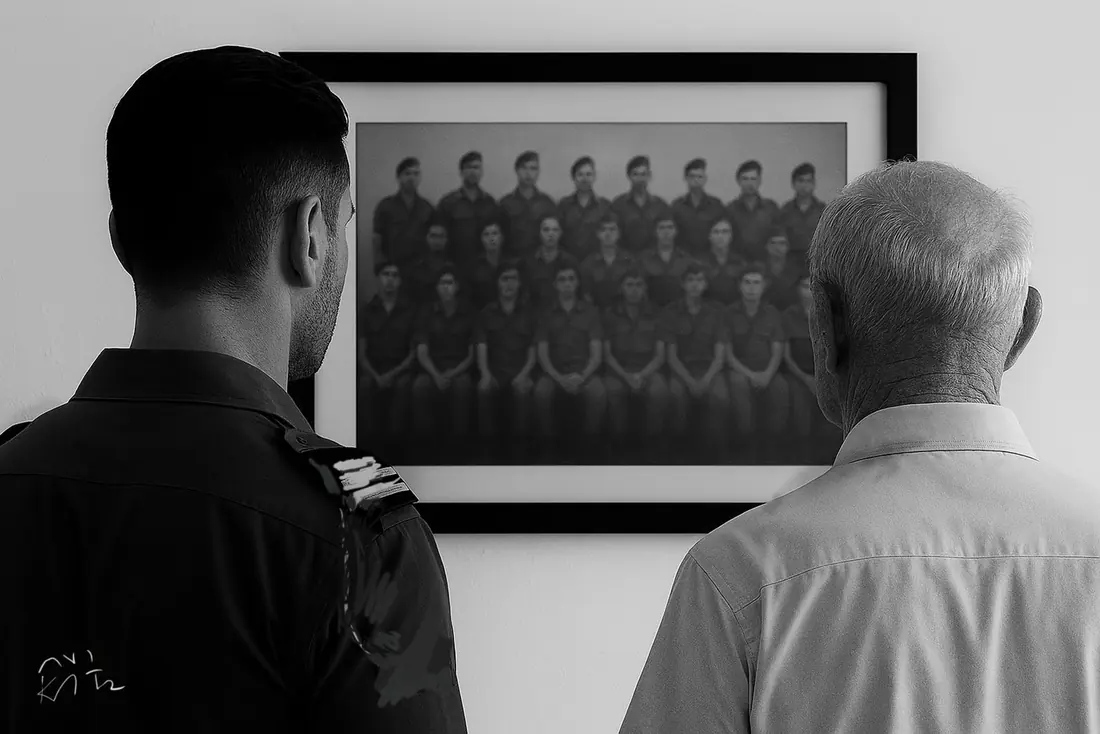
Ido Geffen, “The Girl Who Lived Near the Sun” (2021)
Geffen’s story begins with a comic long-distance family scolding and develops into a melancholy solar-system tale of exile, obligation, distance, and the impossibility of suspending family history. Its speculative apparatus is expansive, but its emotional engine is recognizably Israeli: a family scattered across space yet still bound by guilt, care, expectation, and the pull of home. It broadens the anthology’s earlier range by showing that displacement can be cosmic, domestic, generational, and comic.

Nimrod Eisenberg, “Budapest” (2021)
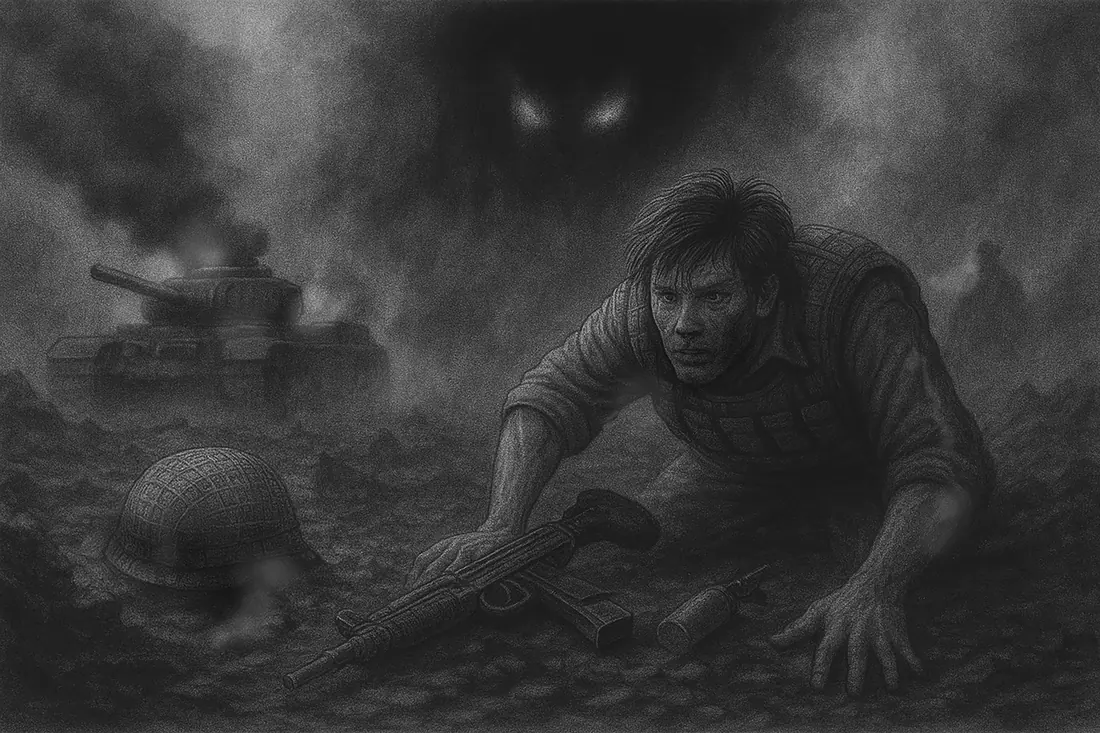
Set at the Bar-Lev Line’s northernmost Sinai outpost during the Yom Kippur War, Eisenberg’s “Budapest” rewrites military history through speculative intervention, bringing an uncanny nonhuman or posthuman presence into the claustrophobic reality of siege, fear, and attrition. The story makes an old national trauma strange again: the outpost is both a historical site and a chamber in which memory, bodily vulnerability, and impossible contact are fused.
Assaf Gavron, “The Cement” (Ha-Melet) (2023)
Gavron’s novella, one of Post-Cap, a 2023 Israeli literary project that commissioned four speculative novellas imagining possible post-capitalist futures, is set in 2066 in a post-capitalist Middle Eastern Union and follows Ami Alalouf, a builder working in the Gulf, as he confronts the legacy of his father Amram’s revolutionary construction material. Its speculative promise of systemic redesign is already cracked by housing pressure, inheritance, development-town memory, Mizrahi grievance, automation, climate extremity, and regional normalization. It belongs as a threshold text: a final pre-rupture horizon of reconstruction and coexistence shadowed by old Israeli debts that no new material can fully seal.
After October 7: Fiction After the Break
Yivsam Azgad, “Inverse Proportions” (2023)
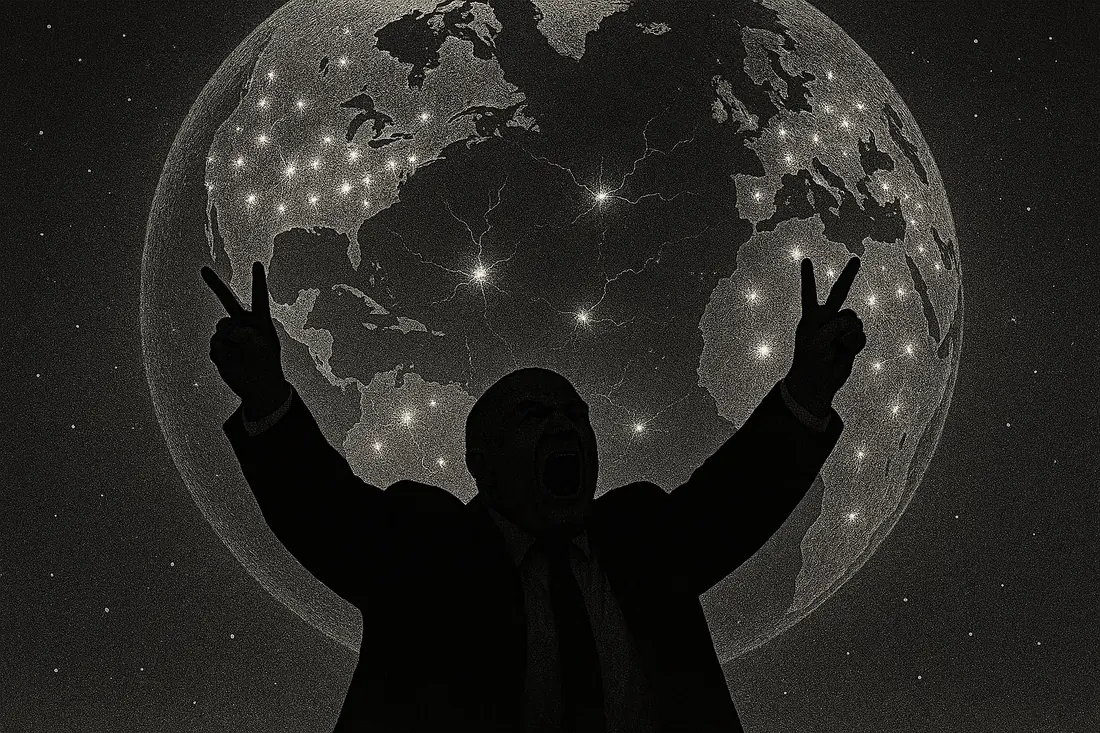
Azgad’s political-theological fantasia begins with a destabilized Middle East and moves toward cosmic farce, messianic escalation, and a surreal collapse of proportion. It uses absurdity not to soften danger but to reveal the grotesque instability of political imagination under existential pressure: apocalypse becomes media event, religious script, strategic crisis, and national hallucination. It marks the threshold into the post-rupture section because it brings geopolitics, fear, leadership, and sacred rhetoric directly onto the stage.
Ilana Bernstein, “You Can’t See the Occupation from Here” (2023)
Bernstein’s story places the narrator inside a procedural, surveilled work environment linked to Mount Scopus, where a shooting death plays on a news loop while employees are trained not to look back, not to ask questions, and not to step outside the movement rules of the institution. Occupation becomes labor discipline, architecture, forbidden glances, news loops, and trained blindness. It is one of the clearest post-rupture answers to the Elephant in the Airlock problem.

Keren Landsman, “Miranda Station Doesn’t Answer” (2024)
Landsman’s title announces a breakdown in contact: a station that should answer has fallen silent, and with that silence comes the dread of systems failure, abandonment, and knowledge arriving too late. The story belongs because it turns communication itself into a measure of catastrophe. It speaks to a literature newly alert to silence, missing signals, delayed rescue, and the unbearable interval between danger and confirmation.

Uri Hannanel, “The Only Candidate Who Came from the Future” (2024)
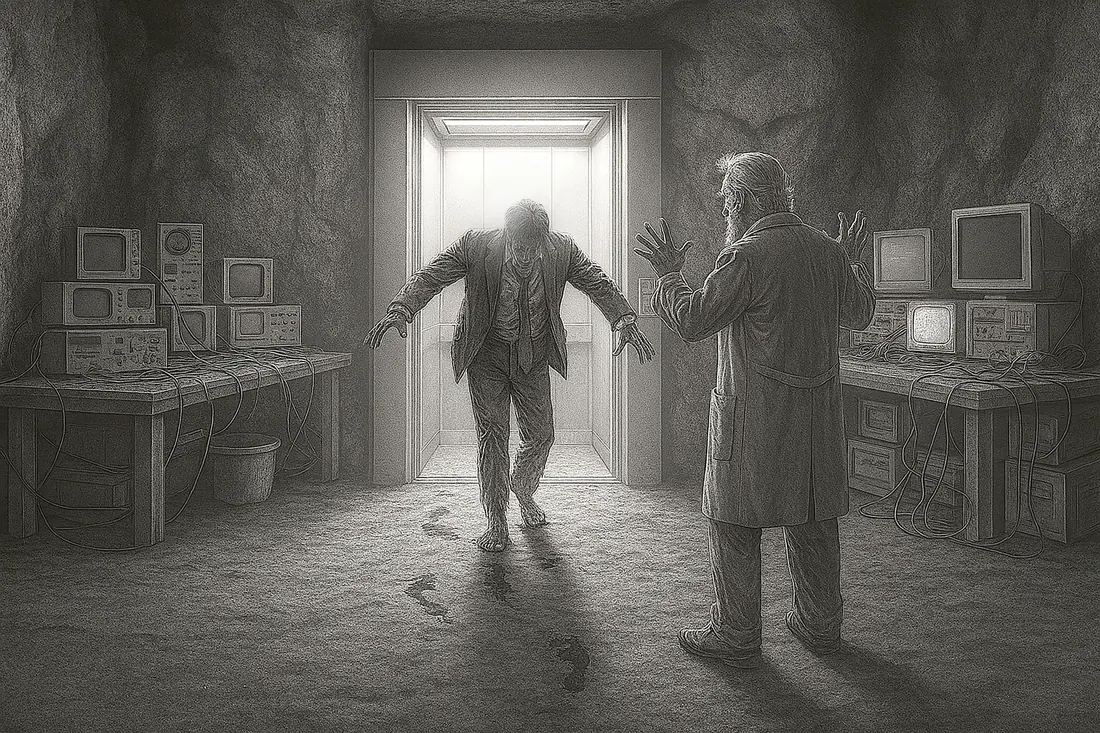
Hannanel’s story unfolds in a cave fitted with electronics, a steel door, and a descending elevator, where an old man waits for a visitor whose mission is political, temporal, and messianic. A wounded emissary brings a message bound up with prophecy, leadership, and a future that seeks to intervene in the present. It fuses Israeli electoral anxiety, emergency governance, and time travel into a single speculative chamber.
Nimrod Eisenberg, “This Never, Ever Happened” (2024)
Eisenberg’s story begins in ordinary domestic routine and gradually reveals itself as a therapeutic pocket universe built around a survivor whose memories of massacre keep breaking through the program designed to contain them. It is one of the anthology’s most direct post-rupture texts because it places trauma treatment, virtual reality, denial, and testimony in immediate collision. The catastrophe returns as glitch, smell, fire, dialogue, and impossible repetition.
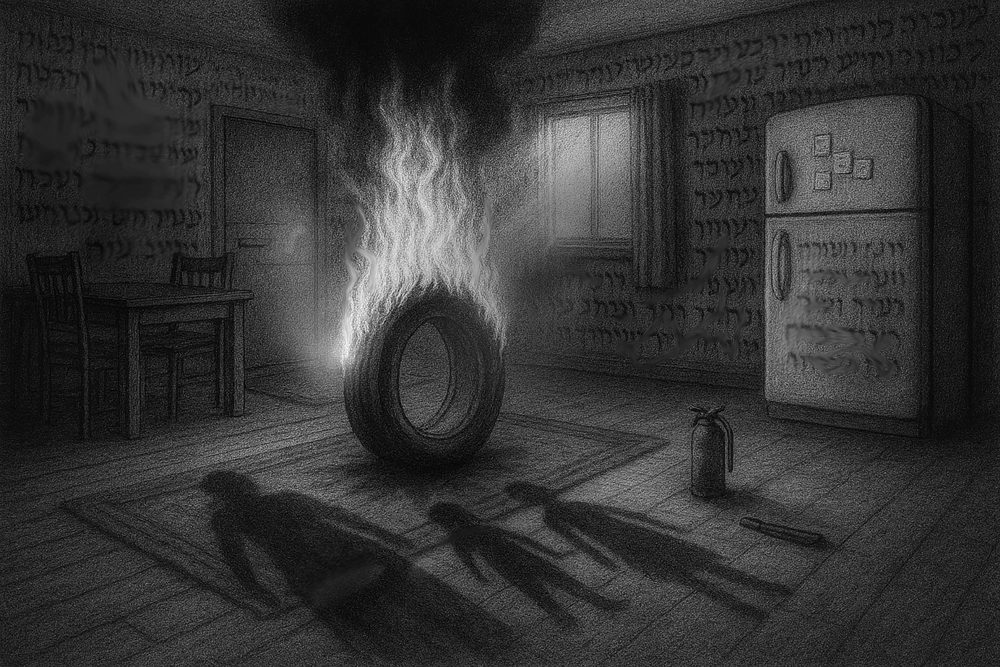
Elana Gomel, “The Shoemaker of Jerusalem” (2024)
Gomel’s story gives voice to the Wandering Jew, a figure originating in Christian legend and historically deployed as an antisemitic trope, and reclaims him as a collector of Jewish testimonies across catastrophe: Roman destruction, Nazi persecution, Ethiopian Jewish migration, alien invasion, and future annihilation all enter a single restless archive of witness. The story places Israeli disaster inside a longer Jewish catastrophe continuum without dissolving its specificity.
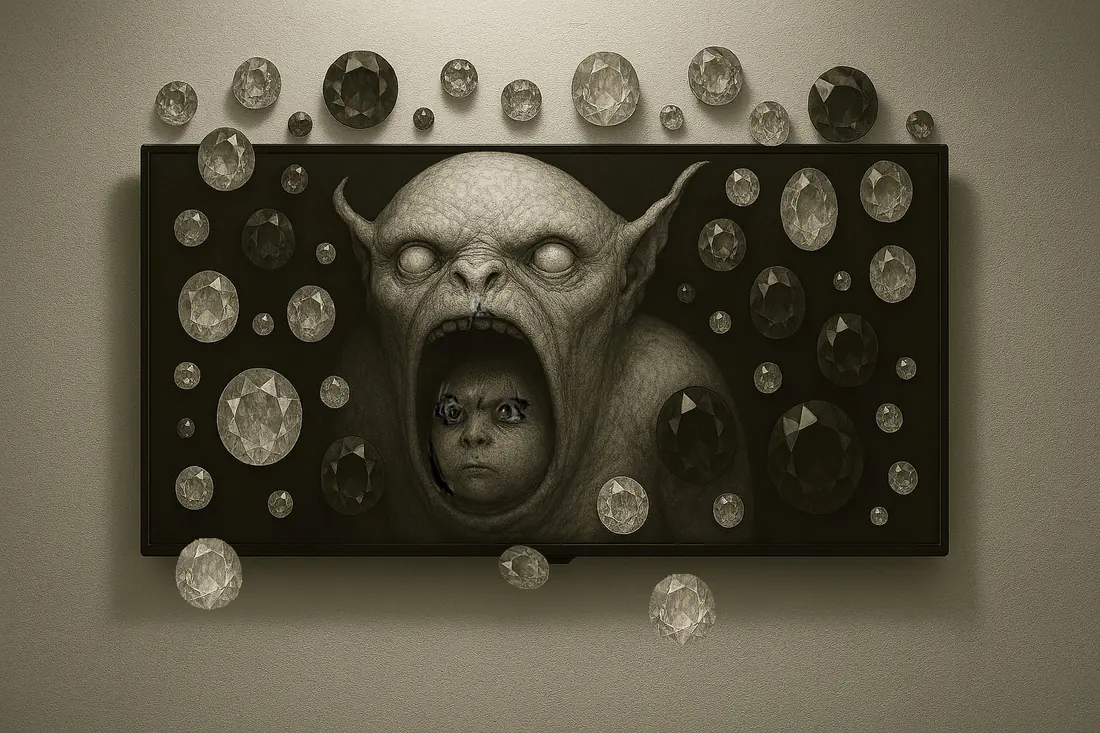
Ayal Hayut-Man, “The Road to Amelas” (2025)
Hayut-Man’s title openly invokes Ursula K. Le Guin’s Omelas while shifting the moral problem into an Israeli landscape of contamination, ascent, memory, and complicity. The story reactivates Le Guin’s unbearable question: what kind of community rests on hidden suffering, and what does it mean to walk away when the road out is itself morally compromised? It supplies an explicit ethical bridge between world SF and Israeli crisis writing.

Shimon Rozenberg, “A Wall in Her Heart” (2025)
Rozenberg’s story makes Jerusalem’s wall an organ in the body of the city. Separation is architectural and emotional at once: the wall is not only a border but something lodged inside the city and the body politic. It belongs because it takes one of the central facts of Israeli and Palestinian life—division made concrete—and turns it into speculative urban anatomy.
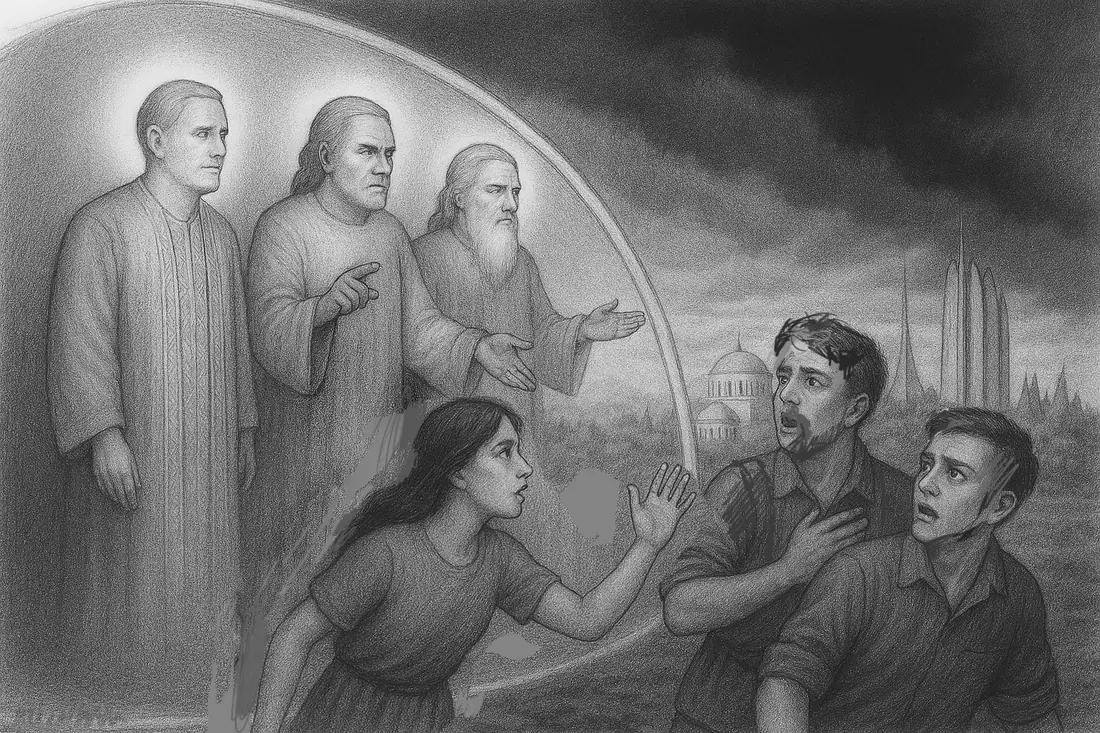
Avigail Koresh, “The Defection” (2025)
Koresh’s story begins in a suffocating visa waiting room and grows into a narrative of alienation, political flight, covert contact, and treason understood as moral necessity. Its narrator is a model citizen in a system that measures conformity, fertility, loyalty, and civic usefulness, yet leaving the world becomes not betrayal of humanity but rejection of a deformed order.
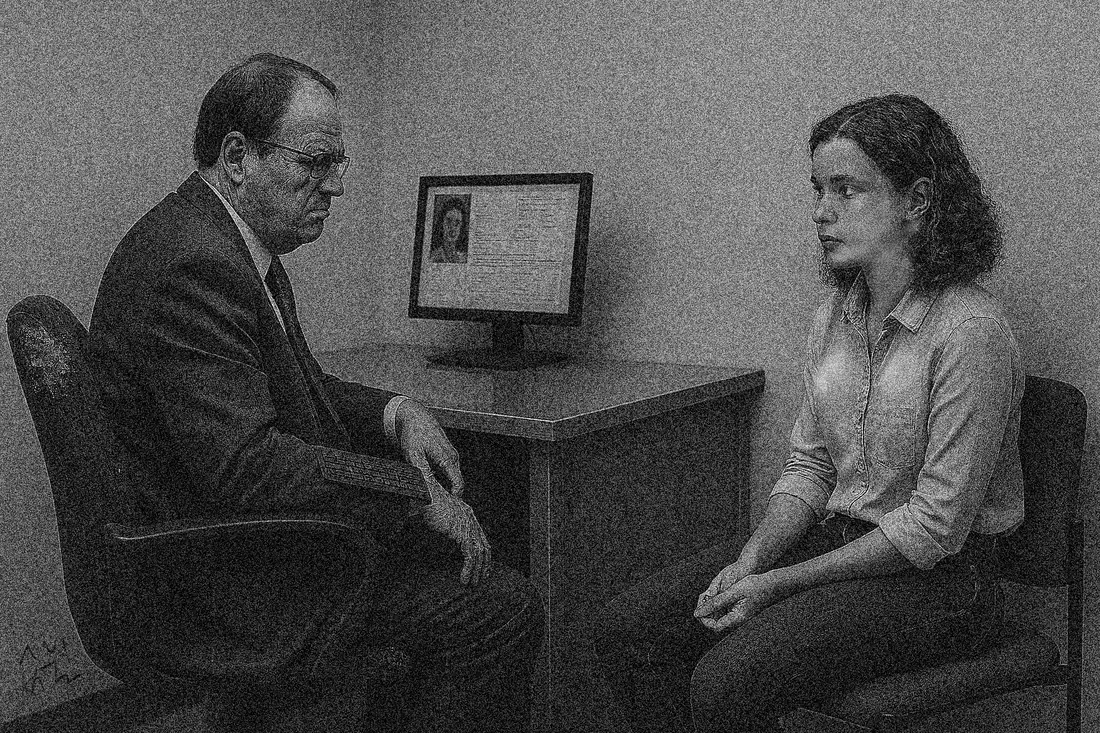
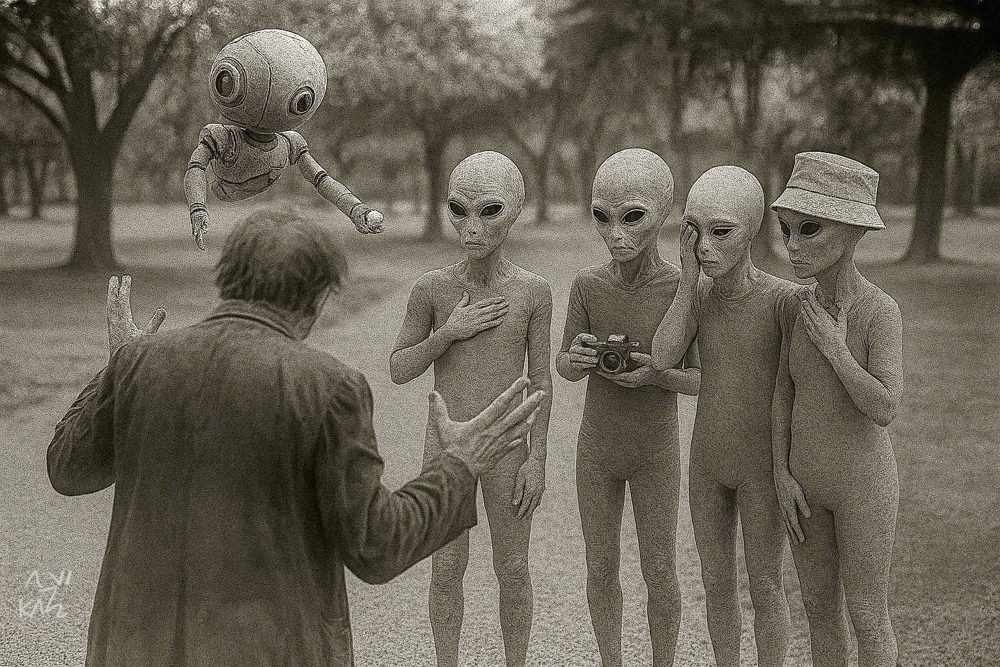
Etgar Keret, “Guided Tour” (2025)
Keret’s compact story follows Meron as he conducts weekly tours for visiting aliens through the ruins of Ramat Gan, offering them ice pops, ruined civic landmarks, and the story of Romeo and Juliet while the human world lies in aftermath. It offers a post-catastrophe mode that refuses solemn inflation. The answer is not triumph or despair, but the fragile human need to keep narrating, explaining, joking, and offering hospitality to strangers.
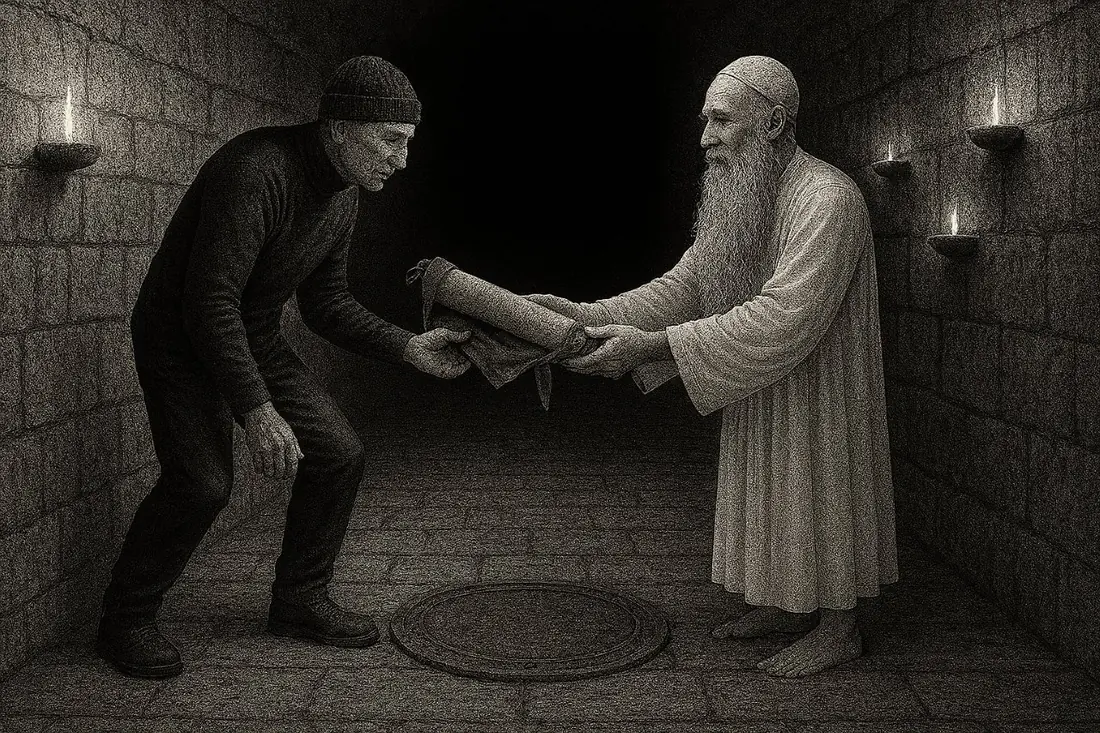
Hezki Zangi, “The Scroll of Metamorphoses” (2025)
Zangi’s story begins in a Jerusalem souvenir shop and follows a narrator drawn into a secretive traffic in fabric, parchment, identities, and transformative power. The scroll of the title can alter people and reality, but its power is inseparable from theft, pilgrimage, Temple politics, kibbutz history, buried texts, and competing claims on the sacred. It makes metamorphosis both a fantasy of escape and a political danger.
Shimon Adaf, “Drainage” (2026)
Adaf’s “Drainage” imagines a post-human or radically revised society governed by Intelligences that have stabilized climate, history, desire, and social possibility by sealing both future and past inside an eternal present. As the anthology’s latest-dated story, it gives the anthology a culminating register: after direct violence, occupation, memory, walls, exile, and ruins, the question becomes whether a society can survive by eliminating risk, uncertainty, and historical rupture altogether.

Why this book, why now
The market is crowded with books about Israel and October 7, overwhelmingly in the forms of reportage, memoir, history, political argument, and polemic. The Elephant in the Airlock occupies a different space. It offers neither a single interpretation nor a prescribed moral conclusion. It gives readers access to the imaginative life of a society on both sides of a historic rupture.
The project also meets a wider international appetite for speculative literature in translation and for fiction that approaches political crisis indirectly. Israeli writers such as Lavie Tidhar have demonstrated that this literature can travel far beyond a narrowly national readership. The anthology supplies a larger context while introducing English-language readers to voices they are unlikely to encounter elsewhere.
The historical rupture provides the book’s immediate point of entry, but not its expiration date. Its enduring subject is how societies imagine danger before it arrives and how imagination changes after danger becomes history.
Readership and market
The primary audience includes readers of international science fiction and fantasy, contemporary literature in translation, Jewish and Israeli literature, and books concerned with the cultural consequences of war and political rupture. The anthology also has clear potential for university courses in speculative-fiction studies, Jewish studies, Israel studies, Middle Eastern studies, translation studies, trauma studies, and contemporary world literature.
Its conceptual structure—before and after a historical rupture—is immediately understandable, while its contents span accessible speculative modes including alternate history, dystopia, satire, fantasy, horror, science fiction, and surrealism.
Comparable and related titles
The direct precedents are Zion’s Fiction: A Treasury of Israeli Speculative Literature and More Zion’s Fiction: Wondrous Tales from the Israeli ImagiNation, co-edited by Sheldon Teitelbaum and Emanuel Lottem. Those books established the field for English-language readers. The Elephant in the Airlock is differentiated by its before-and-after architecture, its concentration on a transformed imaginative landscape, and its deliberate conversation between older fiction and writing produced after the rupture.
The anthology also belongs beside international collections that use speculative fiction to illuminate national and cultural experience, and beside post-crisis literary anthologies that preserve multiple conflicting voices rather than advancing a unified thesis. Its advantages are a sharply defined premise, an editor with an established track record in the field, recognized contributors, and substantial material unavailable to English-language readers.
The editor
Sheldon Teitelbaum is a journalist, critic, editor, and longtime observer of Israeli and international speculative fiction. He co-edited Zion’s Fiction: A Treasury of Israeli Speculative Literature and More Zion’s Fiction: Wondrous Tales from the Israeli ImagiNation with Emanuel Lottem. The project received international recognition, including the 2023 Kurd Laßwitz Special Prize in Germany.
His journalism has appeared in the Los Angeles Times, The New York Times, Wired, The Jerusalem Report, The Jerusalem Post, Hadassah, Cinefantastique, and other publications. His work has ranged across science and technology, literature, film, Israel, Jewish affairs, and war reporting. He has written reference material on Jewish and Israeli science fiction and has followed the Israeli speculative-fiction community for more than four decades.
Born in Montreal and a former Israeli army officer, Teitelbaum has lived and worked in Israel, the United States, and Canada. His combination of editorial experience, journalism, long involvement with the field, and direct familiarity with Israeli history positions him to assemble the anthology without reducing its writers to representatives of a political argument.
Contributors
The anthology will open with a foreword by Larry Niven, one of science fiction’s best-known Grand Masters and a longtime friend of Israeli science fiction. His foreword will introduce the collection to the international science-fiction readership and frame Israeli speculative writing as part of the broader history and conversation of the genre. Valerie Estelle Frankel will contribute the afterword. Israeli illustrator Avi Katz will provide interior story illustrations. The fiction will combine internationally recognized writers with important voices less familiar in English. The final table of contents will depend on permissions, translation status, and final editorial selection.
Manuscript status and specifications
The project is in active development. A substantial body of candidate fiction has been identified, including previously translated material and new work requiring translation or final permissions. The editor has longstanding relationships within the Israeli speculative-fiction community and prior experience selecting, editing, translating, and publishing Israeli fiction for an international readership.
The anticipated manuscript length is approximately 100,000–130,000 words, depending on final selections. It will include an editor’s introduction, Larry Niven’s foreword, brief story introductions where useful, interior illustrations, and Valerie Estelle Frankel’s afterword. A final delivery schedule can be established with the publisher once permissions and translation commitments are confirmed.
Publicity and author platform
The editor brings decades of relationships across science-fiction publishing, journalism, Jewish cultural media, and Israeli literary circles. The two Zion’s Fiction volumes established a network of writers, translators, reviewers, scholars, booksellers, convention communities, and international readers that can be reactivated for this project.
Publicity angles include the transformation of Israeli culture after the rupture; science fiction as a literature of anticipated catastrophe; Israeli writing beyond conventional realism; speculative literature in translation; and the question of whether societies can imagine futures during prolonged war and political crisis. Contributors provide further opportunities for interviews, essays, festivals, podcasts, academic events, and genre-media coverage.
Targeted outreach can include Jewish book festivals, science-fiction conventions, literary festivals, universities, Jewish- and Israel-studies programs, libraries, independent bookstores, and international speculative-fiction media.
The ask
The Elephant in the Airlock is proposed as a trade anthology with serious literary and academic crossover potential. The editor seeks a publishing partner capable of positioning it simultaneously as important contemporary literature and as a distinctive work of international speculative fiction.
Its selling proposition is concise: this is the first major anthology designed to let Israeli speculative fiction speak across the rupture of October 7, revealing what the country imagined before catastrophe and what its writers can imagine afterward.
Materials available
- A detailed working table of contents and story synopses.
- Sample stories and existing English translations.
- Biographical material for contributors.
- Reviews and background relating to Zion’s Fiction and More Zion’s Fiction.
- Translation and permissions information.
- Sample artwork and information about Avi Katz’s proposed contribution.
Translation and editorial method
Translation is a central editorial requirement. All but five of the selected stories were written in Hebrew, and most English-language readers will encounter their authors through the translators’ work.
These stories require first-rate literary translators with an ear not only for contemporary Hebrew but for fiction, voice, rhythm, register, slang, military language, religious reference, political nuance, black humor, and the compressed cultural shorthand of Israeli life. Speculative fiction adds another layer of difficulty: translators must also handle invented terminology, estranged realities, wordplay, technological language, and shifts between the colloquial and the fantastic without flattening the individual styles of the authors.
The project therefore requires a serious translation budget and the ability to engage top-notch Hebrew-to-English literary translators. Where appropriate, translators should be matched to particular writers and stories rather than treating the anthology as a uniform translation assignment. Existing translations will be carefully reviewed, and new translations should be edited in close consultation with the authors whenever possible.
The quality of the English is especially important because the anthology is intended to introduce many of these writers to readers encountering them for the first time. A merely accurate translation is not enough. The English-language stories must work as literature in their own right while preserving the cultural, political, and linguistic particularities that make them Israeli. The publisher’s commitment to translation will therefore be one of the decisive factors in realizing the full potential of the book.